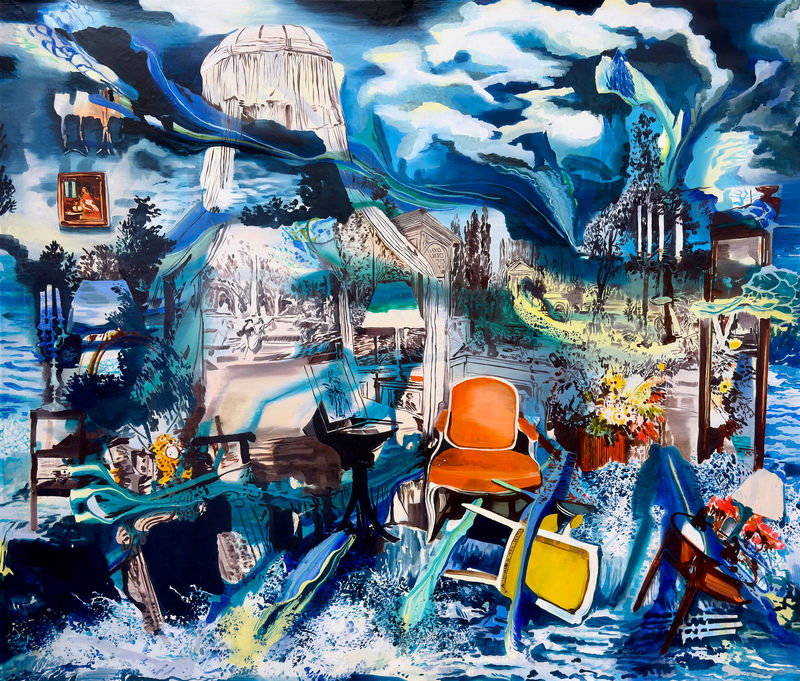
Galerie Nathalie Obadia is pleased to present in Paris La Rupture, a solo exhibition by Texan-born American artist Rosson Crow, featuring nine previously unseen works. A graduate of the School of Visual Arts in New York (2005) and the University of Yale (2006), Rosson Crow now lives in Los Angeles, where her pictorial work has established itself as a major contributor to the art scene of the American West. This exhibition celebrates a partnership of more than twenty years between the artist and the gallery, which had already supported her work before she even graduated in 2006.
Blazing Californian landscapes, submerged Baroque architecture, French château furnishings and other fragmented motifs collide in this body of works in which every shape is flooded with vibrant colour. In these new paintings, with their Pop Art palette, figuration falters but never completely disappears. The visitor is invited to enter this paradoxical world - maximalist yet deserted - where chaos becomes the catalyst for potential change.
This new body of work, while firmly rooted in what is happening in the world, is also the most personal the artist has created to date. It was begun in January 2025, at a time when Los Angeles seemed to be irreversibly falling apart: ashes were still floating above the ravaged neighbourhoods of Pacific Palisades and Altadena, devastated by fires. "Many of us had been feeling this-an uneasy sense of the world shifting beneath our feet," she recalls. This collective stupefaction - fuelled by political upheaval and the breakneck speed of advances in technology - was compounded a few months later by a personal tragedy: the death of her mother, the ultimate symbol of the loss of a sense of belonging and identity. World history and personal history thus converge in the eye of the same storm.
These tensions are captured in every painting. Pool Party Disrupted by LA Fires transposes the hedonist decor of Los Angeles - parasols, palm trees, scorching sun - into a world of incandescent chaos, consumed by flames. The Swell, the first work she created after her mother's death, opens a dreamlike space in which waves overwhelm a Baroque interior. Rosson Crow's painting weaves together American and European heritage in a disjointed, sometimes obliterated, iconography that is subject to the erosion of memory. Each work reflects the emotional turmoil of our times and revolves around a word that has guided the artist throughout this collection: "destabilize".¹
Rosson Crow splits and superimposes images, creating shattered narratives: "Were these memories of a shared history or just a dream?" she wonders. Robert Darnton's reading of The Revolutionary Temper: Paris, 1748-1789 sheds light on this pre-Revolutionary tension, which resonates with our own times, where everything seems set to unravel. From this confusion emerges Revolutionary Spirit Seizes the Cardroom, which blends real and transformed history - the raw materials of our contemporary world.
This temporal and spatial layering is reflected in the techniques used by the artist. Each work begins with a psychedelic poured underlayer, on which a meticulous collage composed of hundreds of heterogeneous sources is applied: a chandelier from a 1940s postcard, a textile motif from a 1960s interior design book, a chair from the Château de Versailles, a rug from a Texan hotel, a floral print from a 1930s magazine, etc. Some details were enlarged then transferred onto the canvas using a multilayered photographic process. The overlaid ink produces an effect similar to collage and manual screen printing. Finally, oil paint unifies the whole, creating a dense and sensual surface. With its accumulations, explosions and fragments of memories, the image becomes an unstable experience: elements are swept into a Vortex - recalling the visual frenzy of James Rosenquist's Speed of Light (1999-2000) - ready to be transformed.
"What remains to be created when the old world has vanished?" wonders the artist. As Above, So Below perhaps provides the answer: sumptuous furnishings inspired by the Château de Versailles are engulfed by lush vegetation. At the heart of these turbulent transitions, however, a profoundly optimistic vision emerges.
According to Rosson Crow, La Rupture is not only a fracture; it is also a threshold. A new energy may arise from the ashes, an unexpected order from the chaos. And, perhaps, at the heart of the tumult, the promise of a metamorphosis.
The exhibition thus becomes a liminal passage, allowing the artist - and, in their turn, visitors - to give birth to their "dancing star".²
- Marie Chappaz, Content Editor
----------------
¹The artist says: "I started this body of work in January 2025 with one word pinned to my studio wall: destabilize."
²Friedrich Nietzsche wrote in Thus Spoke Zarathustra (1883-1885): "... one must still have chaos within, in order to give birth to a dancing star" (trans. Graham Parkes, 2005). These words illustrate the importance of overcoming disorder or destruction to create new opportunities.
